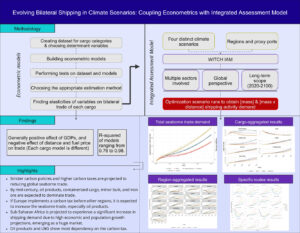
MAGPIE’s Consortium member, TU Delft, has published an article titled “Evolving shipping activity in climate scenarios: Coupling econometrics with Integrated Assessment Model”. Written by Hesam Naghash & Jeroen Pruyn from Work Package 3, which focuses on Energy Requirements and Supply Chains. This paper improves the representation of maritime shipping in Integrated Assessment Models (IAMs) by examining the impacts of climate targets on future shipping demand. A novel econometric model, grounded in advanced gravity theory and integrated with machine-learning algorithms, is proposed to estimate the elasticities of variables in bilateral seaborne trade. By coupling this model with the WITCH IAM, it explores various scenarios, providing deeper insights into trade patterns and their implications. The results show that stricter climate policies and higher carbon taxes reduce GDP due to higher abatement costs and fuel prices, reducing seaborne trade, especially for oil products and containerized cargo. The early adoption of carbon taxes in Europe may shift oil production and consumption patterns, temporarily boosting seaborne trade.