The Challenge
With more than 10 million inhabitants, the Ruhr Area is one of Europe’s most important logistics hubs as well as one of its most congested. Today, 55 percent of all containers arriving at the Port of Rotterdam are moved into the hinterland by truck. The result: overcrowded motorways, rising emissions, and supply chains that are vulnerable to disruption. The infrastructure for a smarter solution already exists but needs to be used.
The Vision: Waterways First, Road Transport on the Last Mile
Our concept rethinks the Rotterdam–Ruhr corridor from the ground up. Instead of defaulting to road transport, containers filled with consumer goods are loaded directly onto barges and transported via the Rhine to the DeltaPort terminals. Here, shipments are stored, consolidated in smaller units for specific target regions, and prepared for final delivery – before being loaded back onto smaller vessel units for distribution.
At the heart of this concept are purpose-built depots positioned along the inland waterways. As needed, vessels call at each depot on a round trip through the West German Canal Network. Shipments are prepared such that infrastructure requirements are kept lean and operations flexible.
From the depots, the final stretch to the customer is covered by cargo bikes and electric transporters. The aim is to reduce the modal split of road freight and shift road transport to the last mile.

Functionality of the Model
Our logistical model integrates transport networks across all modes – inland waterways, rail, and road – and incorporates data on route conditions, capacity, emissions, and transport costs.
Based on a Dijkstra algorithm, it continuously optimizes routing decisions across all modes of transport. For each selected route, the model systematically evaluates and validates all available transport options identifying the most efficient combination in terms of cost, while also indicating its performance in aspect of travel time and emissions. What makes it particularly useful is its ability to account for modal shifts and present multimodal alternatives, allowing the comparative advantages of each mode to be used efficiently.
A key feature of the model is its ability to evaluate dynamic transport mode choices under varying conditions. Time-series and temporal data capture seasonal or time-dependent variations, as well as probabilistic disruptions such as low water levers or congestion. For each scenario, the model determines cost-optimal re-routing across available modes, making synchromodality an operational reality and embedding resilience directly to the logistics chain.
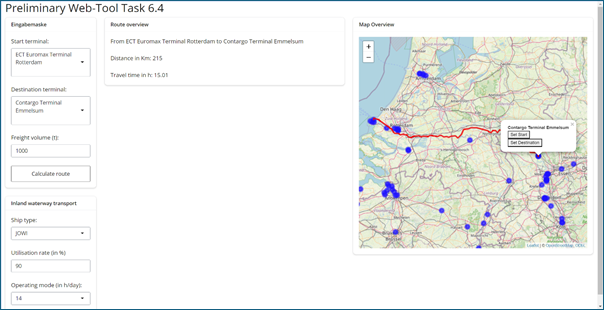
Furthermore, the model is designed to incorporate emerging innovations in route optimization. Autonomous vessel types, for example, can be integrated as additional parameters enabling stakeholders to assess future scenarios, market opportunities, and the commercial potential of next-generation transport technologies in a real-world context.
Why It Matters
Our model addresses the question of how sustainable logistics and commercial viability are not conflicting but complementary. By shifting the primary transport mile onto Europe’s underused waterway network, the concept can relieve pressure on road infrastructure, cut emissions across the supply chain, and build a more robust corridor between Rotterdam and the Ruhr.