Note: This event summary was produced using AI-assisted transcription of the discussions.
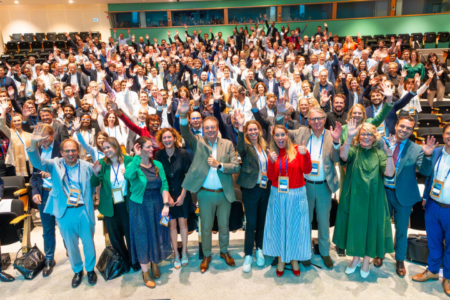
The Transport Research Arena (TRA) conference 2026, held at the HUNGEXPO, Budapest Congress and Exhibition Centre, brought together this year researchers, industry representatives, policymakers, and European projects to discuss the future of transport. Throughout the conference, MAGPIE contributed to technical sessions, poster presentations, and the “Seas to Skies” side event, sharing the outcomes of five years of work on the decarbonisation of European ports.
The first day of the conference opened with MAGPIE contributions to the technical programme. Four members of the consortium presented different aspects of the project and its findings.
Maarten Flikkema introduced the broader context of MAGPIE through his keynote, “Navigating to Clean and Smart Logistics to, from and in Ports.” His presentation outlined the project’s approach to reducing emissions across port logistics chains, combining alternative fuels, digital tools, modal shift and operational improvements.
Jorrit Harmsen from TNO addressed the human dimension of the transition with his presentation, “Just Transition: (Un)foreseen Impact in Shipping.” His intervention examined the social consequences of decarbonisation and innovation, highlighting that technological change also affects workers, skills and communities connected to port activities.
Miklós Doma and Celeste Muilwijk from PoR presented “CO₂ & Pollutant Reduction via Port Traffic Redistribution.” Their work, carried out in collaboration with IFPEN, explored how redistributing port-related traffic flows can help reduce emissions and air pollutants, demonstrating that logistics organisation itself can become a lever for decarbonisation. This collaboration between PoR and IFPEN also highlighted how a smooth transition from digital tools to impactful decisions can already be achieved today.
The first day thus set the tone for MAGPIE’s presence at TRA: decarbonisation was approached not only as a technological challenge, but also as a logistical and social one.
The second day expanded this perspective. Alongside the main conference, TRA hosted the second edition of the “Seas to Skies” event, bringing together Green Deal projects from the port and airport sector, including MAGPIE, PIONEERS, TULIPS, STARGATE and OLGA and illustrating common challenges and converging approaches between the port and airport sectors.
The initiative created a space for exchanges between projects working in different transport environments but facing similar challenges. There, participants from ports & airports European projects discussed how multimodal hubs will contribute to climate-neutral transport systems. The event highlighted, however, that the green transition requires coordination between infrastructures that have historically evolved separately.
It is, in that context that MAGPIE representatives Maarten Flikkema from FIMC and Tommaso Spanevello from HAROPA PORT contributed to the session “Ports as Resilient, Smart and Green Energy Hubs.” The discussion explored how port and airport authorities are evolving into actors of the energy transition, navigating the practical realities of implementation while responding to changing regulatory and economic contexts.
The session dealt with the questions of energy resilience, infrastructure adaptation and operational and reflected a broader shift: ports are no longer considered solely as gateways for goods, but increasingly as integrated energy ecosystems.
Later in the day, Jaco van Meijeren from TNO participated in the session “Smart and Autonomous Mobility.” The session examined the technologies transforming transport systems and the ways automation and intelligent systems are reshaping mobility ecosystems, both on land and at sea. Automation emerged not simply as a question of replacing existing processes, but of redesigning operations, improving efficiency, and supporting sustainability objectives. The session was the opportunity to outline the implementation barriers associated with deploying autonomous solutions in real operational environments.
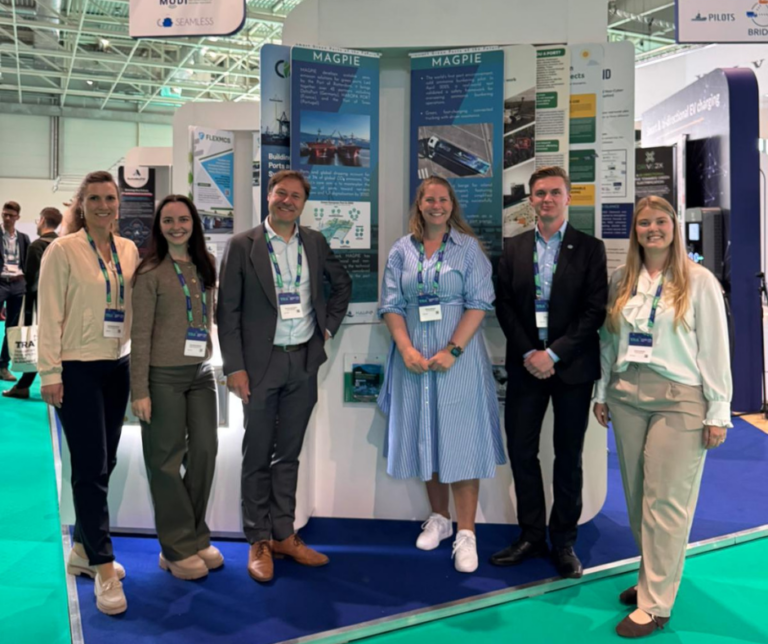
Throughout the day, MAGPIE also maintained a presence beyond the conference rooms: visitors could meet consortium members at the MAGPIE stand in the ALICE Logistics Innovation Theatre and discuss the project’s smart green port solutions. Poster sessions further extended these exchanges.
Oscar van de Water from TNO presented his study on onshore power demand for container ships, contributing to discussions on port electrification and future energy requirements.
Another contribution addressed the question of implementation beyond demonstration activities. The paper “From Demonstration to Deployment: Overcoming Barriers to Zero-Emission Innovation in European Ports,” authored by Hannah Mosmans and Larissa van der Lugt from Erasmus UPT and presented by Arne-Jan Polman, examined the obstacles that innovations encounter when moving towards wider adoption. Their paper embodies one of MAGPIE’s core learnings: technical maturity alone does not guarantee deployment.
The “Seas to Skies” event continued into the third day of the conference, shifting attention towards digitalisation, transferability and future policy directions. The morning programme included the session “Digitisation & Modelling for Cleaner Ports and Airports.” During this session, Zenaida Mourão from INESTEC presented “Advancing Decarbonisation and Green Logistics with MAGPIE Digital Tools.” The presentation focused on the suite of digital solutions developed within MAGPIE to support greener logistics operations. These included tools dedicated to greenhouse gas emissions analysis, modal shift optimisation, energy matching and operational planning. Among them were the GHG Tool for transport chain emissions, the Smart & Green Logistics platform supporting hinterland modal choices, and the Energy Matching Tool designed to balance local renewable energy supply and demand.
The session also addressed broader questions surrounding digitalisation. Participants discussed data availability, interoperability and the development of future digital twin architectures capable of supporting more informed decision-making processes. While several tools currently rely on historical or synthetic datasets, future developments point towards greater integration of real-time operational information.
Alternative fuels also represented another major theme, where discussions highlighted continuing constraints related to production capacity, blending infrastructure, and logistics coordination. Hydrogen deployment was addressed through demonstrations presented within the TULIPS project. Attention focused not only on the demonstrations themselves but also on upstream questions concerning hydrogen production, transport, storage, and business models required for wider deployment. A recurring message emerged across these sessions: technologies cannot simply be copied and pasted from one context to another. Frameworks for decision-making and adaptation may prove more transferable than individual technical solutions.
The final Seas to Skies session, “Regeneration of Sustainable Ports & Airports: Market Uptake, Policy Recommendations, Future Calls, Key Exploitable Results and Transferability,” brought these different strands together. Representatives from the projects reflected on what remains once demonstrations conclude. A common observation emerged across the five initiatives. Innovation alone is insufficient.
Projects had namely to address regulatory frameworks, stakeholder engagement, social acceptance, market conditions, and organisational change. They had to understand how solutions could be reproduced in other contexts and under different constraints. Transferability therefore became a central part of the discussion. The legacy of these projects lies not only in the technologies they developed, but also in the pathways they identified for future implementation. MAGPIE returned to this theme during the session “The European Green Deal large projects: success stories in ports and airports greening and digitalization” where Maaike Dalhuisen presented MAGPIE’s vision and roadmap for sustainable and smart port operations. She highlighted the project’s efforts to develop a repository of good practices, solutions and innovations intended to support replication across Europe. This repository forms part of MAGPIE’s longer-term contribution: documenting not only what worked, but under which conditions, and how future initiatives may build upon existing experience.
The session situated MAGPIE’s role in informing future policy priorities. After five years of work, participants considered how large collaborative projects contribute to competitiveness, resilience and sustainability through both technological developments and lessons learned.
As the conference drew to a close, Budapest marked the end of another chapter in MAGPIE’s journey. Across technical presentations, poster sessions, side events and informal exchanges, the project shared experiences accumulated through five years of demonstrations and collaboration. The discussions repeatedly returned to similar questions.
How can innovations move from pilots to deployment? How can infrastructures adapt to new energy systems? How can digital tools support operational decisions? How can transitions remain attentive to their social implications? And how can solutions developed in one context become relevant elsewhere?
TRA 2026 did not offer a single answer to these questions. Instead, it demonstrated that the transition of ports and airports relies on the interaction between technologies, organisations, policies, and people. When the sessions ended and participants departed Budapest, the work itself remained ongoing.